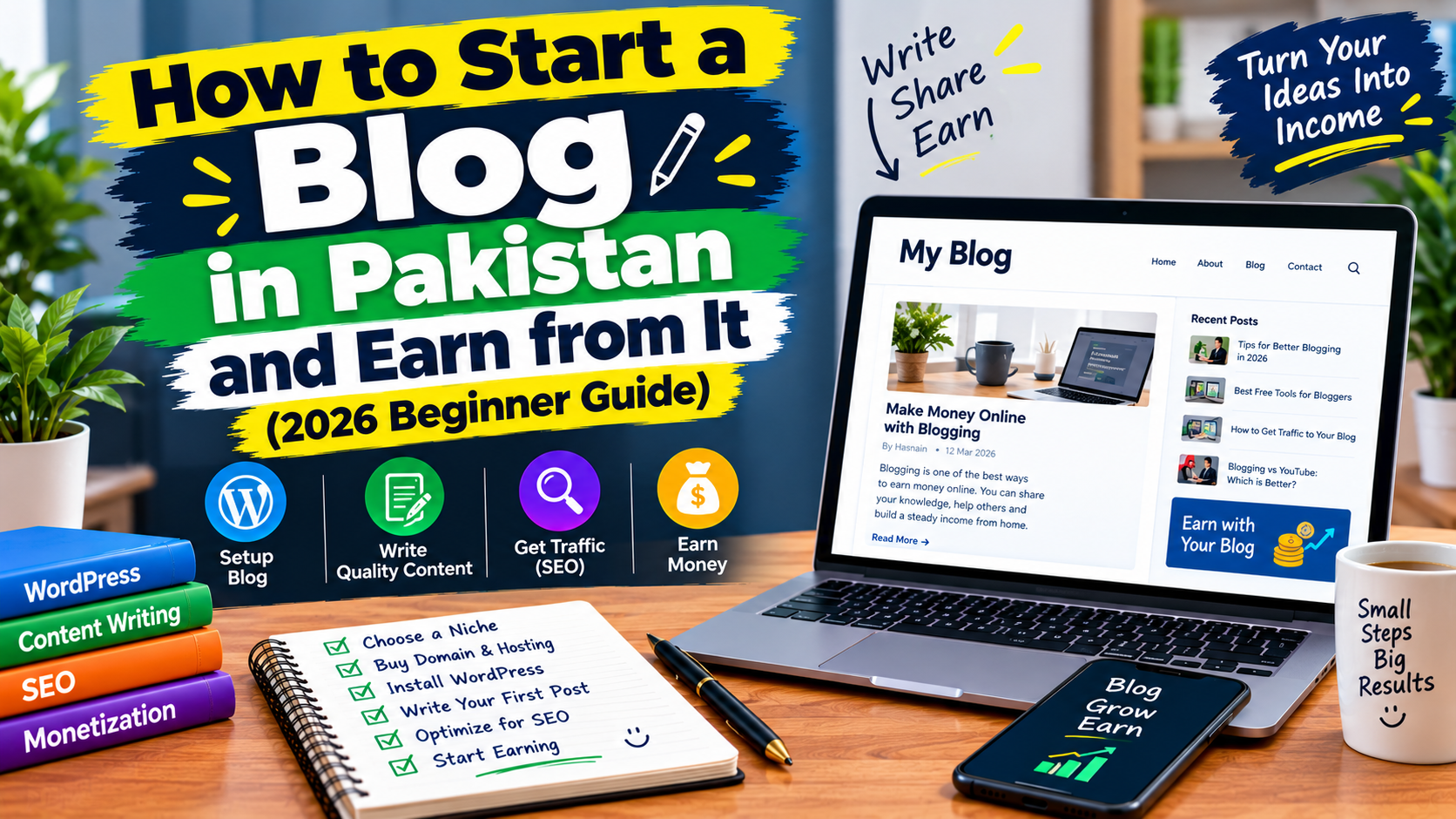
Blogging is one of the most popular ways to build an online income in Pakistan, but it is also one of the slowest. A blog is a website where you publish helpful articles on a topic. If readers find your articles useful, your traffic can grow, and over time you may earn money through advertising, affiliate links or services.
In this guide you will learn how to start a blog in Pakistan, what it costs, how to choose a topic, how to write your first posts and how blogs earn. Please remember that most blogs take months before they earn anything, and some never earn much. Blogging rewards patience, honesty and quality.
What Is a Blog and How Does It Earn?
A blog is a website with regularly published articles. People find your articles through search engines like Google, social media or other websites.
Blogs can earn in several ways:
- Advertising. Ad networks such as Google AdSense show ads on your website, and you may earn when visitors view or click them, depending on the program’s rules. AdSense approval is not automatic, and you must follow its policies.
- Affiliate marketing. You recommend a product or service, and you may earn a commission if someone buys through your link. You must clearly tell readers when links are affiliate links.
- Sponsored content. A company may pay you to write about their product. This usually requires a good audience and honest disclosure.
- Your own products or services, such as a course, an e-book or freelance work found through your blog.
No method gives guaranteed income. Traffic and trust come first.
Step 1: Choose a Niche You Can Stick With
A niche is the main topic of your blog. A focused blog is easier for readers and search engines to understand than a blog about everything.
Good niche ideas for beginners:
- Freelancing and online skills
- Education and study tips
- Technology and mobile guides
- Health and fitness basics (be careful, and only share safe, well-checked information)
- Cooking and food
- Travel in Pakistan
To choose well, ask yourself:
- Do I know or enjoy this topic enough to write 30 or more articles?
- Do people search for this topic? Look at related searches on Google and see what people ask.
- Can I give useful, honest answers? Choose topics where you can add real value.
Be careful with topics that can harm readers if the information is wrong, such as health, money and legal advice. Always use trusted sources and add clear disclaimers.
Step 2: Choose a Domain Name and Hosting
Your domain is your website address (for example, yourname.com.pk), and hosting is the service that stores your website online.
Domain tips:
- Choose a name that is short, easy to spell and related to your niche.
- Avoid numbers and hyphens if possible.
- Make sure the name does not copy another brand.
- Dot-com and dot-com-dot-pk domains are both common choices. Check current prices, because they vary.
Hosting tips:
- Choose a reliable provider with good speed, support and backups.
- Read recent reviews before you pay.
- Be careful with very cheap offers that look too good to be true.
- Make sure the plan supports WordPress and an SSL certificate (the secure “https” lock).
Prices change often, so compare a few providers and read the terms before buying.
Step 3: Install WordPress
WordPress is a free and widely used website system. Most hosting providers can install it for you in a few clicks. After installing, log in to your dashboard and do the basic setup:
- Set your site title and tagline in Settings > General
- Enable https
- Set your permalinks to “Post name”
- Delete the sample posts and pages
- Choose a clean, lightweight theme and install only the plugins you really need
Step 4: Create the Essential Pages
Before you rely on ads, your blog should look trustworthy. Create these pages:
- About Us: who you are and what the blog is about
- Contact Us: a working email address or form
- Privacy Policy: explains how you handle visitor data, cookies and ads
- Disclaimer: explains that your content is general information
- Terms and Conditions
Add them to your footer menu so visitors can find them on every page.
Step 5: Plan Your First 10 Articles
Before you start writing, make a list of questions your readers want answered. Good blog posts solve a clear problem.
A simple way to find topics:
- Type your niche in Google and note the suggested searches
- Look at the “People also ask” box
- Notice the questions people ask in Facebook groups and forums
- Write about your own experience and the problems you solved
Start with beginner-friendly topics, such as “how to” guides, checklists and honest comparisons.
Step 6: Write Helpful, Original Articles
This is the most important step. Search engines and ad networks both prefer content that is useful, original and written for people.
Writing tips:
- Aim for articles that fully answer one question, and make them as long as they need to be, not longer.
- Use a clear title, headings, short paragraphs and bullet points.
- Write in simple language.
- Add your own experience, examples and images.
- Check facts using reliable, official sources, and keep your articles updated.
- Add a short disclaimer on topics like money, health and legal matters.
Do not:
- Copy articles from other websites
- Publish text you have not read or checked, including text generated by AI tools
- Make false promises like “earn Rs. 5,000 daily”
- Use images you have no right to use
If your English needs improvement, read our guide on how to improve your English for freelancing in Pakistan.
Step 7: Learn Basic SEO
SEO (search engine optimisation) helps people find your articles on Google. The basics are simple:
- Use the main topic words in your title and in the first paragraph
- Use clear headings (H2 and H3)
- Write a short meta description for each post
- Add internal links to your other related posts
- Use descriptive image names and alt text
- Make sure your website loads quickly and works well on mobile
- Submit your sitemap to Google Search Console
SEO does not replace quality. It helps good content get found.
Step 8: Get Your First Visitors
A new blog usually gets few visitors at first. Be patient and use several channels:
- Google Search, which can take weeks or months to build
- Facebook groups, Pinterest and short videos, where you share genuinely helpful content
- Your own friends and community
- Answering questions on forums, without spamming your links
Do not buy fake traffic or click your own ads. Both can get your account banned.
Step 9: Think About Earning After You Have Content
When your blog has enough quality articles and some regular visitors, you can think about earning.
Google AdSense. You can apply when your site has original content, the required pages and a clear structure. Approval depends on the program’s policies, and there is no fixed traffic number or timeline. Read the official AdSense policies first.
Affiliate links. Join the affiliate program of a company you genuinely trust and recommend only what you believe is useful. Always disclose affiliate links.
Other income. A good blog can help you build a name and find clients for services such as writing or design. See our guides on creating a Fiverr account in Pakistan and building an Upwork profile.
If you earn income from your blog, remember that it may be taxable in Pakistan. Check current rules with a qualified tax professional.
How Much Does It Cost to Start a Blog?
The main costs are usually a domain name and hosting, which are yearly or monthly fees. You can start with free or low-cost tools, but prices and plans change, so compare current offers. Your biggest investment is your time.
How Long Does It Take to Earn?
It varies. Some bloggers see their first small earnings after several months, and others take a year or more. Many blogs never earn much. Treat blogging as a long-term project, not a quick way to make money.
Common Mistakes Beginners Make
- Choosing a topic only because it pays well, not because they can write about it
- Publishing very few articles and giving up after a month
- Copying content, which can get a site rejected from ad programs or removed from search results
- Ignoring the essential pages like Privacy Policy and About
- Using fake traffic or clicking own ads
- Making unrealistic income claims
- Not updating old posts
- Falling for scams that sell “guaranteed blogging income”. Read our guide on how to avoid online earning scams in Pakistan.
A Simple 30-Day Starter Plan
Week 1: Choose your niche, domain and hosting, and install WordPress.
Week 2: Set up your theme, logo and the essential pages.
Week 3: Write and publish your first 3 to 4 articles.
Week 4: Write 3 to 4 more, add internal links, and submit your sitemap to Google Search Console.
Then aim for a steady schedule, such as two or three good articles a week.
Frequently Asked Questions
Can I earn from a blog in Pakistan?
Yes, it is possible, but it takes time and the results vary. Most bloggers need months of consistent work before they earn.
How much money do I need to start?
You mainly need a domain and hosting, plus your time. Costs change, so compare current prices.
Do I need to know coding?
No. WordPress lets you build a blog without coding.
Is AdSense approval guaranteed?
No. Google reviews each site, and approval depends on content quality and policy compliance.
Can I write a blog in Urdu?
Yes. Urdu blogs can work, especially for local topics. English often has more advertisers, but both are valid choices.
Can I write articles with AI tools?
You can use them as a helper, but you should read, correct and rewrite the text, and add your own experience. Do not publish unchecked or copied text.
Conclusion
Starting a blog is simple, but making it succeed needs patience. Choose a niche you can stay with, write honest and helpful articles, build the essential pages and keep learning. Focus on helping readers first, and earning can follow over time.
Next, read our guide on how to earn money with YouTube in Pakistan.
Disclaimer: This article is for general information only. Earnings are not guaranteed. Costs, policies and program rules change, so please check the official websites of each service before you act. This is not financial or tax advice.