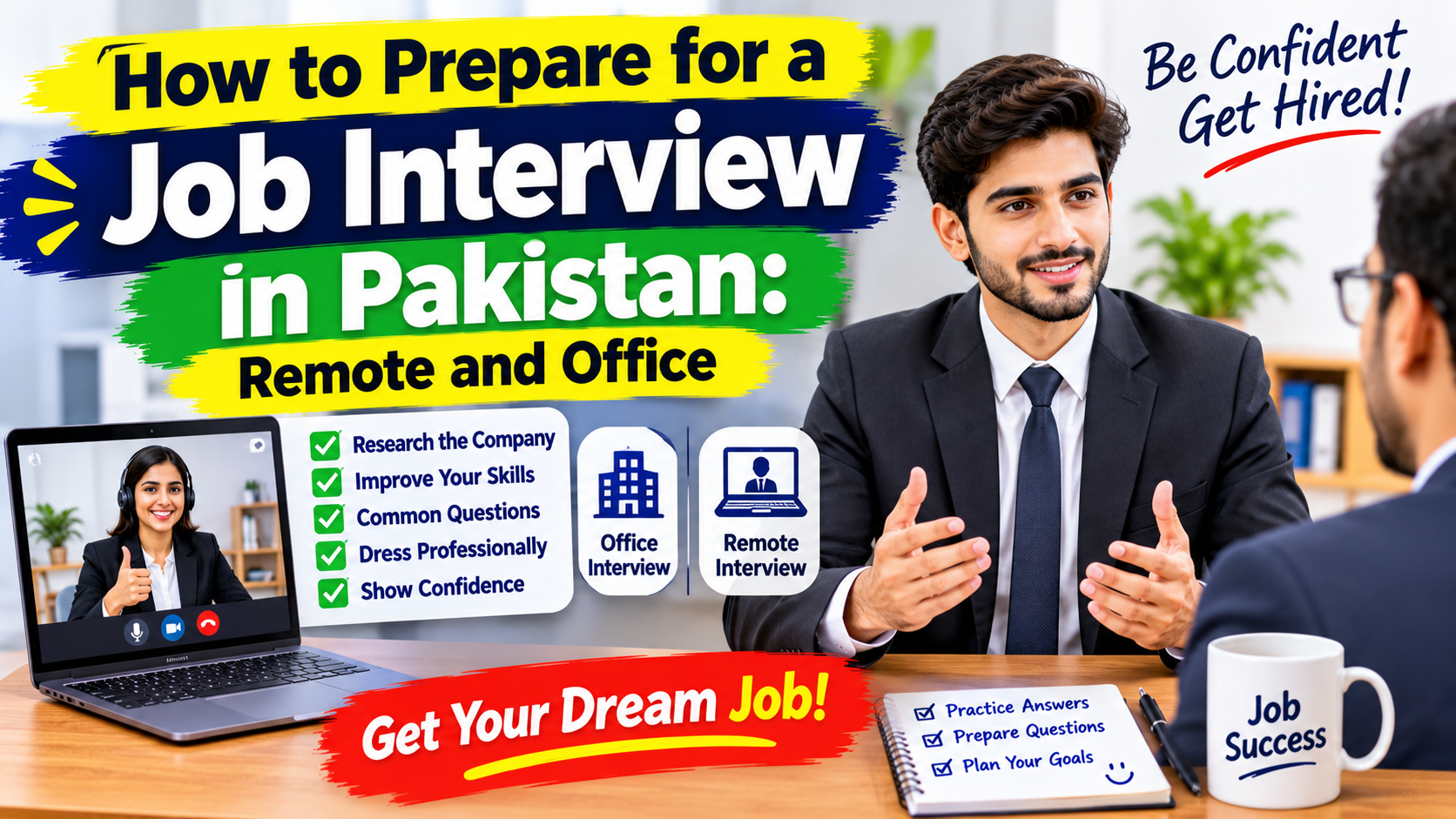
Getting an interview call is exciting, but many people feel nervous because they do not know what to expect. The good news is that interviews become much easier when you prepare. Employers are not only checking your skills. They also want to see how you communicate, how honest you are and whether you can solve problems.
In this guide you will learn how to prepare for a job interview step by step, how to answer common questions, how to handle online interviews and which mistakes to avoid. Please remember that good preparation improves your chances, but it cannot guarantee a job.
If you have not yet prepared your CV, read our guide on how to make a CV for remote jobs in Pakistan first.
Step 1: Understand the Job and the Company
Before you do anything else, read the job description again carefully. Note the main duties, the skills they want and any tools they mention. Then learn about the company:
- What does the company do?
- Who are its customers?
- What are its products or services?
- What is its size and where is it based?
- What do you find on its official website and LinkedIn page?
Use only reliable sources, and do not repeat rumours. If you can say one or two true, specific things about the company, it shows that you are interested.
Be careful before you attend any interview from an unknown company, especially one that asks for money. Check our guide on how to find real remote jobs in Pakistan without paying anyone.
Step 2: Prepare a Short Introduction About Yourself
“Tell me about yourself” is the most common interview question. Prepare a clear answer of around 1 minute.
A simple structure:
- Who you are: your name, your education or background
- What you do: your skills and experience
- Why you are here: why this job matches your skills
Example:
“My name is Ali, and I recently completed my degree in business studies. For the last year I have been practising content writing and have written several blog posts as samples. I enjoy research and clear writing, and I am applying for this role because it matches my skills and I want to grow in this field.”
Keep it honest, short and natural. Do not memorise it like a poem. Practise it aloud a few times.
Step 3: Practise Common Interview Questions
Think about these questions and prepare your own honest answers.
“Why do you want this job?”
Explain what interests you about the role and how it fits your skills and goals. Avoid answers that are only about salary.
“What are your strengths?”
Choose 2 or 3 strengths that are relevant to the job and give a short example for each.
“What are your weaknesses?”
Choose a real weakness that is not essential to the job, and explain how you are improving it. For example: “I used to feel nervous when speaking in meetings, so I started practising presentations with friends.”
“Tell me about a challenge you faced.”
Describe the situation, what you did and what you learned. Keep it short and positive.
“Why should we hire you?”
Match your skills to the job requirements. Be confident, but not arrogant.
“Where do you see yourself in five years?”
Show that you want to learn and grow. Avoid unrealistic answers.
“Do you have any questions for us?”
Always prepare two or three questions. Examples: “What would a typical day in this role look like?” and “How is success measured in this position?”
Step 4: Use the STAR Method for Experience Questions
For questions like “Tell me about a time when…”, use the STAR method:
- Situation: Describe the context.
- Task: Explain what you needed to do.
- Action: Say what you did.
- Result: Share the outcome.
If you have no work experience, use examples from your studies, volunteer work, practice projects or freelance samples. Always tell the truth.
Step 5: Prepare Your Documents and Samples
Have these ready:
- A few printed copies of your CV, if the interview is in person
- Your CNIC and any documents the company asked you to bring
- Certificates, if requested
- A portfolio or samples of your work, if relevant
- A notebook and pen
For remote jobs and freelancing, prepare a link to your samples. If you offer a skill such as design, see our guide on how to learn graphic design with Canva for free.
Step 6: Prepare for Online and Phone Interviews
Many remote jobs use video calls. Prepare the technical side in advance.
- Test your internet, camera and microphone before the interview.
- Choose a quiet place with good light on your face.
- Check the platform (Zoom, Google Meet or another) and join a few minutes early.
- Charge your device, and keep a backup option such as mobile data.
- Look at the camera when you speak, if you can.
- Close other apps and silence your phone.
- Keep your CV and notes nearby, but do not read your answers word for word.
If the connection drops, stay calm. Reconnect and politely apologise.
Step 7: Improve Your Communication
Clear communication is very important, especially in remote work.
- Speak slowly and clearly.
- Listen to the full question before you answer.
- Keep your answers focused. One or two minutes is usually enough.
- If you do not understand a question, politely ask the interviewer to repeat or explain it.
- Use simple, correct language. If English is a challenge, read our guide on how to improve your English for freelancing in Pakistan.
Step 8: Dress and Behave Professionally
- Dress neatly and simply, even for an online interview.
- Be on time. Plan to arrive early, or join the call a few minutes before the start.
- Greet the interviewer politely.
- Sit straight and keep a calm, friendly manner.
- Thank the interviewer at the end.
Step 9: Be Honest About Salary
If the employer asks about your expected salary, avoid a random number. Research what similar roles usually pay in Pakistan and choose a reasonable range. If you are not sure, you can say that you would like to learn more about the role first and that you are open to a fair offer. Be polite and honest.
If the job pays in foreign currency, or you work as a freelancer, you will need a payment method. Read our guide on how to create a Payoneer account in Pakistan.
Step 10: Follow Up After the Interview
Send a short thank-you message within a day. Thank them for their time, say that you enjoyed learning about the role and confirm your interest.
Example:
“Thank you for the interview today. I enjoyed learning more about the role and the team. I remain very interested in the position, and I look forward to hearing from you.”
If you do not hear back after the time they mentioned, you can send one polite follow-up message.
Common Interview Mistakes to Avoid
- Not preparing and knowing nothing about the company
- Arriving late or joining an online call late
- Speaking badly about previous employers or teachers
- Giving false information or exaggerating skills. Interviewers often test claims.
- Giving very short or very long answers
- Using your phone during the interview
- Asking only about salary and holidays
- Not asking any questions at the end
- Paying money for a job. Real employers do not charge candidates. Read our guide on how to avoid online earning scams in Pakistan.
A Simple Interview Checklist
One week before: Read the job post and research the company. Prepare your introduction and answers.
One day before: Check your documents, your clothes and the interview location or link. Test your device for online interviews.
On the day: Arrive or join early. Stay calm, listen carefully and answer honestly.
After the interview: Send a thank-you message and keep applying to other jobs.
Frequently Asked Questions
How do I control my nervousness before an interview?
Prepare well, practise aloud, sleep properly and take a few slow breaths. Some nervousness is normal and does not mean you will fail.
What should I do if I do not know the answer?
Be honest. You can say, “I am not sure, but I would find out in this way,” and then explain how you would learn or solve it.
Is it okay to ask about salary in the first interview?
It is better to wait until the employer brings it up, or until the later stage of the process. If the job post lists the salary, you can refer to it politely.
How long does it take to hear back after an interview?
It varies. You can politely ask about the timeline at the end of the interview.
Can I use AI tools to prepare?
Yes, you can use them to practise questions and get ideas. But you should answer in your own words and with your own real experience.
What if I have no experience?
Talk about your education, projects, practice work and willingness to learn. Be honest, and show your effort and attitude.
Conclusion
Interview success comes from preparation, honesty and clear communication. Learn about the company, prepare your introduction and examples, practise common questions, test your technology for online calls and follow up politely. Keep improving after every interview, and you will become more confident over time.
Next, read our guide on how to find your first freelance client in Pakistan.
Disclaimer: This article is for general information only. A good interview does not guarantee a job. Employers’ processes and requirements vary, so please follow the instructions given by each company.